
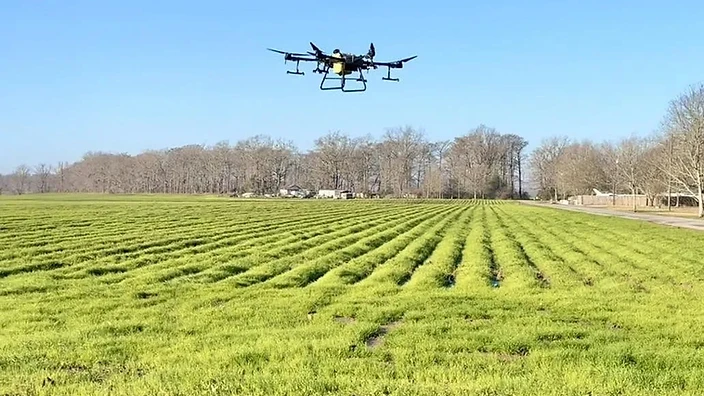
Last week's Texas Crop and Weather Report included a line North Texas hay producers had been dreading. In the North district, "pasture mealybug was identified in parts of the district, and scouting for the pest was underway" (AgriLife Today, Oct. 27, 2026).
This is the invasive insect behind the "pasture dieback" that has been killing out patches of Texas pasture and hay ground since spring 2025. By early October, the Texas & Southwestern Cattle Raisers Association put the count at 79 confirmed Texas counties. It also cited AgriLife estimates that the pest threatens more than 20 million acres, and nearly 36 million if it gets established in the 56 counties considered at imminent risk (TSCRA via North Texas e-News, Oct. 8, 2026).
So the obvious question is whether to spray now. For most North Texas pasture, our answer is no, not this month. November is when you find out where you stand, so next season's treatment is one that actually works.
What the same report says about North Texas conditions
The mealybug line didn't come alone. The North district summary from the same week described:
- Only scattered showers, with drought holding back winter forages and wheat.
- Ponds still short of full and burn bans still in place.
- Minimal growth on warm-season grasses.
- Pastures that bounced back after the early-October rains but were drying down again.
- Some producers already feeding hay.
The weather data says the same thing. The National Weather Service in Fort Worth reported Severe (D2) drought along the I-35/35E corridor from Dallas south, and Extreme (D3) drought in Lamar County and parts of Delta, Hopkins and Fannin counties, even after 2 to 8 inches of rain fell in the 30 days ending Oct. 19 (NWS Fort Worth, Oct. 20, 2026). Statewide, the Oct. 29 U.S. Drought Monitor still had 67.55% of Texas in moderate drought or worse (USDM). And DFW's average first freeze is Nov. 22 (NWS).
Why spraying dormant, droughty grass is a weak bet
AgriLife Extension's updated fact sheet (September 2026) is unusually clear about why mealybug treatments fail. The main reason is poor insecticide coverage in tall, thick grass canopies. Its recommended sequence is:
- Reduce the biomass. Cut or shred the grass, and bale it off where you can.
- Let it regrow to 6 to 8 inches. The products that work against pasture mealybug "must have green leaf tissues to work."
- Treat only after regrowth, and only when mealybugs are detectable.
It also warns that efficacy may be reduced under drought. When grass stops actively growing, mealybugs can move down into the thatch and soil, where they get less exposure to the insecticide (AgriLife Extension, ENTO-PU-248).
Now put that next to the North district report: minimal warm-season growth, drought, and a freeze on the calendar. You can't get 6 to 8 inches of green regrowth on dormant bermudagrass in late November. And the fact sheet notes that females can overwinter in the soil under dry or cold conditions. Spending money on a full-field insecticide pass right now mostly buys peace of mind, not control.
What to do in November instead
Scout the edges, not the dead middle. AgriLife says to focus on yellowing, slightly reddening or poorly growing grass. Check the edges of damaged patches more than the center. Look on the undersides of lower leaves and in the thatch at the soil surface. On hay ground 14 to 30 days after cutting, pull a stem back at the soil line. The insects range from under 1 to 5 millimeters long, and the youngest nymphs need a magnifier. Symptoms are often mistaken for nutrient deficiency or drought stress.
Report it. If you find mealybugs in a county that hasn't been reported yet, AgriLife asks you to contact your county Extension agent. TDA also takes reports at PlantQuality@TexasAgriculture.gov or (512) 463-7660 (TDA).
Stop moving it yourself. TDA lists shared mowing equipment, hay harvesting equipment and infested planting material as suspected ways the pest spreads. Work clean fields before infested ones, and clean equipment between fields.
Make the hay decision with real numbers. AgriLife beef cattle specialist Jason Banta says most operations don't need to buy extra hay. The exception is operations that count on stockpiled introduced forages like bermudagrass, bahiagrass or Old World bluestem. If mealybug is expected to cut that stockpile, he says it would be wise to buy extra hay to cover the loss (AgriLife Today, Oct. 27).
Where drone application fits next season
Once a field qualifies for treatment, meaning the canopy has been knocked down, there's 6 to 8 inches of green regrowth and mealybugs have been confirmed, timing and coverage decide whether the money works. That's where aerial application earns its place:
- Nothing rolls across the infested stand. TDA points to equipment as a likely way the pest spreads between fields. A drone treats the field without a ground rig driving through the grass.
- Spot and block treatment. Damage tends to show up as patches that spread. Mapped, GPS-guided application lets you treat the active edges and the buffer around them instead of paying for every acre.
- Fast turnaround in a short window. The labeled option is limited. AgriLife lists one Centric 40WG application per cutting under its Section 18 emergency exemption (7-day pre-harvest interval for hay), and TSCRA notes that control lasts an estimated 21 to 28 days. When the regrowth window opens after rain, you want to be able to treat that week.
One caution we give every customer: the label and the Section 18 terms decide what can be applied, at what rate and by what method, not the applicator. Before we quote a mealybug job, we confirm that the product and the application method are allowed for your site. AgriLife also recommends a methylated seed oil adjuvant and warns against pyrethroids, carbamates and organophosphates, which have been ineffective in trials or hurt the natural enemies that help keep mealybugs in check.
A note on the equipment side
The spray drone industry is also dealing with a regulatory fight. The American Spray Drone Coalition estimates that U.S. sales of new spray drones fell 59% from 2024 to 2025, while acres sprayed by drone rose about 59% to more than 16 million. These are industry estimates. The coalition has asked the FCC to exclude Part 137 spray drones from a proposed ban on foreign-made "military-grade" drones and to allow two years of spare-part imports. As of Oct. 21, the FCC had not adopted that proposal (DroneXL, Oct. 23, 2026). If you're planning spring work, book with an operator who has the aircraft, parts and paperwork in place now.
Plan it now, apply it when the grass is ready
Exodrone AG holds FAA Part 107 and Part 137 certification and Texas Department of Agriculture License #0918668, is fully insured, and brings more than 10 years of experience in aerial application. We cover Kaufman, Rockwall, Hunt, Collin, Ellis, Cooke and the rest of our North Texas service area.
See our pasture and rangeland program, what we do for ranchers and landowners, or request a quote with your acreage and what you're seeing. Call or text (972) 891-9085.
Follow along on TikTok and Instagram @exodroneag and on Facebook at facebook.com/exodroneag.