
North Texas finally caught a real rain this weekend. DFW Airport recorded 0.54 inches on Sunday, Nov. 15, which was most of the month's total so far. Even with it, the airport is at 0.60 inches for November against a normal of 1.43, and 4.76 inches since Sept. 1 against a normal of 8.52 (NWS Fort Worth climate report, Nov. 16, 2026).
Out in the country the picture is just as uneven. In the Nov. 10 Texas Crop and Weather Report, AgriLife's North district reporters said about an inch fell early that week in parts of the district. It helped soil moisture but did nothing for ponds. Other areas stayed in extreme drought, with burn bans in place and ponds extremely low or completely dry. Winter wheat was 73% planted and 45% emerged, some producers were dry sowing and waiting on rain for a stand, and the crop was rated very poor to fair. Hay feeding had already started where forage was short (AgriLife Today, Nov. 10, 2026). A week earlier, the same district reported grain wheat held back by dry soil or a spike in Hessian fly (AgriLife Today, Nov. 3, 2026).
So why talk about weeds now? Because a good rain after a long dry spell is the starting gun for winter annual weeds. And the forecast says there's more rain coming.
The forecast: a wet El Niño winter, if it shows up
Tom Bradshaw, meteorologist-in-charge at the National Weather Service in Fort Worth, told the Texas Farm Bureau Radio Network that NWS is predicting above-normal rainfall over almost all of Texas this month as El Niño strengthens. Texas State Climatologist John Nielsen-Gammon said strong El Niños "generally produce wet weather from October through April, especially October through February, and somewhat cooler than normal temperatures" (Texas Farm Bureau, Nov. 11, 2026).
Two cautions. First, an outlook is odds, not a promise. This week's U.S. Drought Monitor showed big improvements in South and West Texas, while exceptional drought got worse in East Texas (U.S. Drought Monitor, Nov. 12, 2026). Second, a wet pattern has a cost. AgriLife's Ronnie Schnell noted in October that repeated rains could keep equipment out of fields (AgriLife Today, Oct. 20, 2026). NOAA's Climate Prediction Center releases its next seasonal outlooks on Nov. 19 (CPC release schedule).
Our take: winter weed control will be won or lost on timing, and access
Texas A&M AgriLife's weed science team is blunt about winter annual broadleaves like henbit, chickweed and horseweed: in most grass pastures there's no true preemergence option, so prevention means catching them while they're small. Their advice is to scout after that first fall rain, then treat small, actively growing weeds before bloom (AgriLife Extension Weed Science, Forages newsletter, Sept. 2026).
AgriLife forage specialist Vanessa Corriher-Olson's timing for other common winter weeds points the same way (Forage Fax, Dec. 5, 2025):
- Thistles and dandelions: treat in the rosette stage, before the flower stalk. Older thistles are harder to kill and may need higher rates.
- Buttercup: late February or early March, before it flowers.
- Groundsel: rosette stage, around March.
Put that calendar next to the forecast. The best spray windows run from now through early spring, and that's the same stretch El Niño tends to make wettest. If the rain comes the way NWS expects, a lot of North Texas pasture and wheat ground will be too soft for a tractor right when the weeds are small enough to control cheaply. Wait until the ground firms up and you may be spraying bigger, tougher weeds at higher rates, or rutting the pasture you're trying to protect.
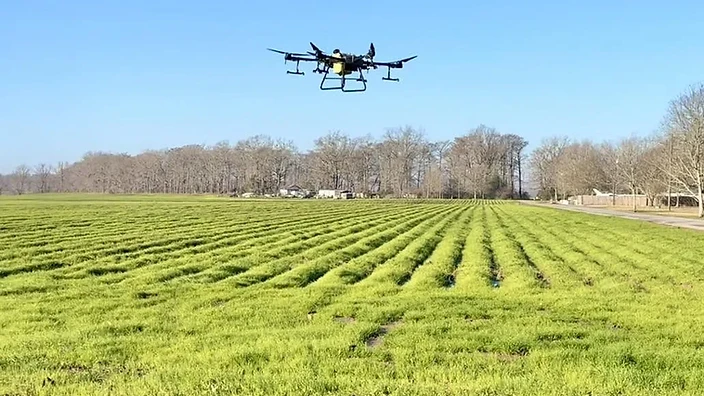
That's where a drone earns its place. It doesn't touch the ground, so a wet week doesn't cancel the job, and it doesn't leave tracks across dormant bermudagrass or emerging wheat. It can also treat the patches where weeds actually came up instead of the whole place.
What to do this month
- Walk your pastures two to three weeks after this rain. Look in thin spots, around hay-feeding areas, along fence lines, and anywhere the summer drought or mealybug opened up the stand. Drop a pin on your phone wherever you find seedlings or rosettes.
- Identify the weeds. Henbit, chickweed, thistle, buttercup and groundsel don't all call for the same product or timing. Your county Extension agent can help.
- Settle your overseeding plans before you choose a herbicide. AgriLife warns that Cimarron Plus and Amber can injure ryegrass, clover or alfalfa planted afterward. Check the label before you spray ground you plan to overseed.
- On wheat or winter pasture you'll graze, read the label's grazing and haying restrictions before anything goes out.
- Don't spray weeds you haven't found yet. If a pasture is still too dry to germinate much, you're paying for herbicide that has nothing to hit. Scout first.
Where drone application fits, and where it doesn't
We'll be straight about the limits:
- The label decides. Product, rate, application method, grazing intervals and any aerial restrictions come from the label, not from us. If a product's label doesn't allow the way we'd apply it, we don't apply it that way.
- Weather still matters. Wind, rain right after application, and cold snaps that stop weeds from actively growing can all push a job back, with or without a tractor.
- Big, dry, flat and uniform ground may be cheaper with a ground rig. Drones make the most sense on wet or rough ground, patchy infestations, fence lines and places equipment can't reach without tearing up the stand.
If you want a plan in place before the wet stretch hits, start with our weed and brush control and pasture and rangeland services. If you run wheat or other crops, see our page for farmers and crop producers. For ranch and land owners, there's a page for ranchers and landowners. We work across North Texas, including Kaufman, Rockwall, Hunt, Collin, Ellis and Dallas counties (all service areas).
Exodrone AG flies under FAA Part 107 and Part 137, holds Texas Department of Agriculture License #0918668, and is insured.
A note on the spray drone headlines
You may have seen news about federal limits on foreign-made drones. Here's where it stands. The FCC is still weighing a proposed ban on imports and sales of foreign drones in categories it calls "military-grade," which include spray drones. As written, the proposal would take effect 180 days after publication in the Federal Register, it leaves drones that owners already have untouched, and an FCC official said a transition period was possible (DroneXL, Nov. 3, 2026). Some U.S. distributors are already planning to move toward domestic manufacturing (DRONELIFE, Nov. 12, 2026). None of it is final. Whoever you hire, ask to see their Part 137 certificate and TDA license.
Still dealing with pasture mealybug? Read our earlier post: Pasture Mealybug Hits North Texas: Why November Is for Scouting, Not Spraying.
Get on the calendar before the ground gets soft
Call or text (972) 891-9085, or request a quote with your county, rough acreage and what you're seeing. We'll review the property, confirm what the label allows, and tell you honestly whether a drone is the right tool for the job.