
On Nov. 13, USDA named 11 Texas counties primary natural disaster areas because of drought: Collin, Cooke, Dallas, Denton, Ellis, Grayson, Montague, Parker, Tarrant, Upton and Wise. Eighteen more Texas counties qualify as contiguous, including Hunt, Johnson, Kaufman and Rockwall (USDA Farm Service Agency, Nov. 13, 2026).
Together, those lists cover all 12 North Texas counties we serve, from Wise to Kaufman.
It's a fast-track drought designation: during the growing season, the U.S. Drought Monitor showed those counties in severe drought (D2) for eight or more consecutive weeks, or in extreme (D3) or exceptional (D4) drought.
What the designation actually unlocks
The designation opens one specific door: FSA emergency loans. From FSA's program page (FSA Emergency Farm Loans):
- Who: farmers and ranchers who operate in a designated county (primary or contiguous) and had substantial losses. You also have to show you can't get enough credit elsewhere.
- What for: replacing livestock, equipment or structures, paying production costs for the coming season, essential family living expenses, refinancing certain disaster-related debts (not real estate), and reorganizing the operation.
- How much: up to 100% of actual production or physical losses, capped at $500,000. Terms for crop, livestock and non-real-estate losses typically run 1 to 7 years.
- Deadline: applications are due within eight months of the designation date. For this designation, FSA lists June 21, 2027.
It is not a grazing-loss payment. That's a separate program.
The other deadline: LFP, March 1, 2027
The Livestock Forage Disaster Program (LFP) pays for drought grazing losses on owned or cash-leased pasture. It's keyed to how the Drought Monitor rated your county during the normal grazing period, not to the disaster designation. Under the updated rules on FSA's site, four consecutive weeks of D2 triggers one monthly payment and seven of eight weeks of D2 triggers two. D3 at any time triggers three, and longer or more severe drought pays more (FSA, Livestock Forage Disaster Program).
Applications are due March 1 after the end of the calendar year in which the loss happened, so March 1, 2027 for 2026 losses. FSA asks for proof of grazing losses, leases or ownership, and livestock inventory. Whether your county triggered, and for how many months, is a question for your local USDA Service Center, not for us.
North Texas is now split in two
In the Nov. 17 Drought Monitor county statistics, Kaufman, Rockwall, Hunt and Dallas counties were still 100% in severe drought or worse, and about a fifth of Kaufman County was in extreme drought. Collin was about 86% in severe drought or worse, and Ellis about 66%. On the west side, Parker and Wise were about 90% and 87% out of drought entirely, and Cooke showed no drought, just abnormally dry ground across most of the county (U.S. Drought Monitor data tables, map of Nov. 17, 2026). Statewide, the share of Texas in drought fell from 54% to 43% in a week, mostly on heavy rain in central and southeastern Texas (U.S. Drought Monitor narrative, Nov. 19, 2026).
AgriLife's North district reporters saw the same split: rain that arrived Sunday helped topsoil in much of the district, but some areas got less than half an inch and others nothing meaningful. Extreme drought held on in parts of the district. Wheat was more than half planted, with about half of those acres up and rated very poor to fair, and hay pastures slowed down quickly with the cooler, shorter days (AgriLife Today, Texas Crop and Weather Report, Nov. 17, 2026).
NWS Fort Worth expects temperatures well below freezing in many areas Tuesday night, likely with a freeze warning, and another areawide freeze Wednesday night (NWS Fort Worth, Nov. 23, 2026). For practical purposes, that closes out the season for warm-season grass. Your bermudagrass goes into winter in whatever shape it's in this week.
Our take: the real cost of this drought shows up in April
The deadlines matter, but the bigger risk is what a drought-thinned pasture does next spring.
AgriLife forage specialists put it plainly: pastures with little or no green growth are living off their roots. If those roots aren't replaced, bare areas grow and "invader grasses/weeds will prevail." They also warn that if a pasture isn't managed properly during drought recovery, invasive species establish and are hard to get rid of (AgriLife Today, Sept. 5, 2022).
We've seen this before. After the 2022 drought, AgriLife's Vanessa Corriher-Olson reported in June 2023 that many bermudagrass stands were still struggling even with good moisture. The causes were drought stress, overgrazing and fertilizer that got skipped the year before. Her advice was to start with a soil test, and she noted that uncontrolled broadleaf weeds outcompete bermudagrass for fertilizer, moisture and sun (AgriLife Today, June 21, 2023).
What to do between now and green-up
- Mark the dates. LFP: March 1, 2027. Emergency loans: June 21, 2027.
- Keep records now. Hay bought, cattle sold or moved, pasture you couldn't graze. FSA will want them.
- Rest the worst pastures. AgriLife's guidance is to defer severely drought-stressed warm-season pastures until dormancy, and to graze to no shorter than 3–4 inches of stubble when you do. Feeding in a single sacrifice paddock keeps the damage in one place.
- Don't spray stressed weeds. AgriLife warns that herbicides applied during drought often don't get into the plant, which means a high-cost application with little control. Wait for actively growing weeds, and read our winter weed timing guide for what to scout.
- Pull soil samples this winter so fertilizer decisions are made before green-up, not after. AgriLife advises applying when moisture is present or about to arrive.
- Pin the bare spots. That's where weeds show up in March.
Where a drone fits, and where it doesn't
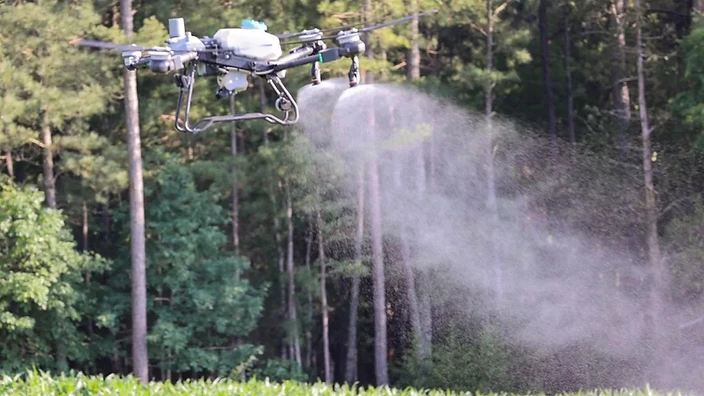
A drone won't fill out an FSA form or bring a stand back without rain and fertility. Where it helps in a recovery year:
- Patchy problems. After a drought, weeds come up in the thin spots, feeding areas and fence lines, not evenly across the place. Spot treating them is what weed and brush control by drone is built for.
- Wet ground. If spring rains finally come, a drone can apply granular fertilizer or broadcast seed without rutting a soft pasture. See seeding and fertilizer.
- Honest limits. The label decides the product, rate and method. Wind and weather still matter. And big, dry, uniform fields may be cheaper with a ground rig.
More for landowners: pasture and rangeland, ranchers and landowners and farmers and crop producers. We cover Kaufman, Rockwall, Hunt, Collin, Dallas, Ellis, Tarrant, Denton, Johnson, Parker, Wise and Cooke counties (all service areas). Still watching for pasture mealybug? Read Pasture Mealybug Hits North Texas.
Exodrone AG flies under FAA Part 107 and Part 137, holds Texas Department of Agriculture License #0918668, and is insured.
Plan your spring before the rush
Call or text (972) 891-9085, or request a quote with your county, rough acreage and what the drought left behind. We'll review the property, check the label, and tell you honestly whether a drone is the right tool.